
New Feature
Attention Capture
A new dimension of media quality: how visual pacing affects children's attention, learning, and cognitive development.
What Is It?
Measuring visual stimulation with flicker
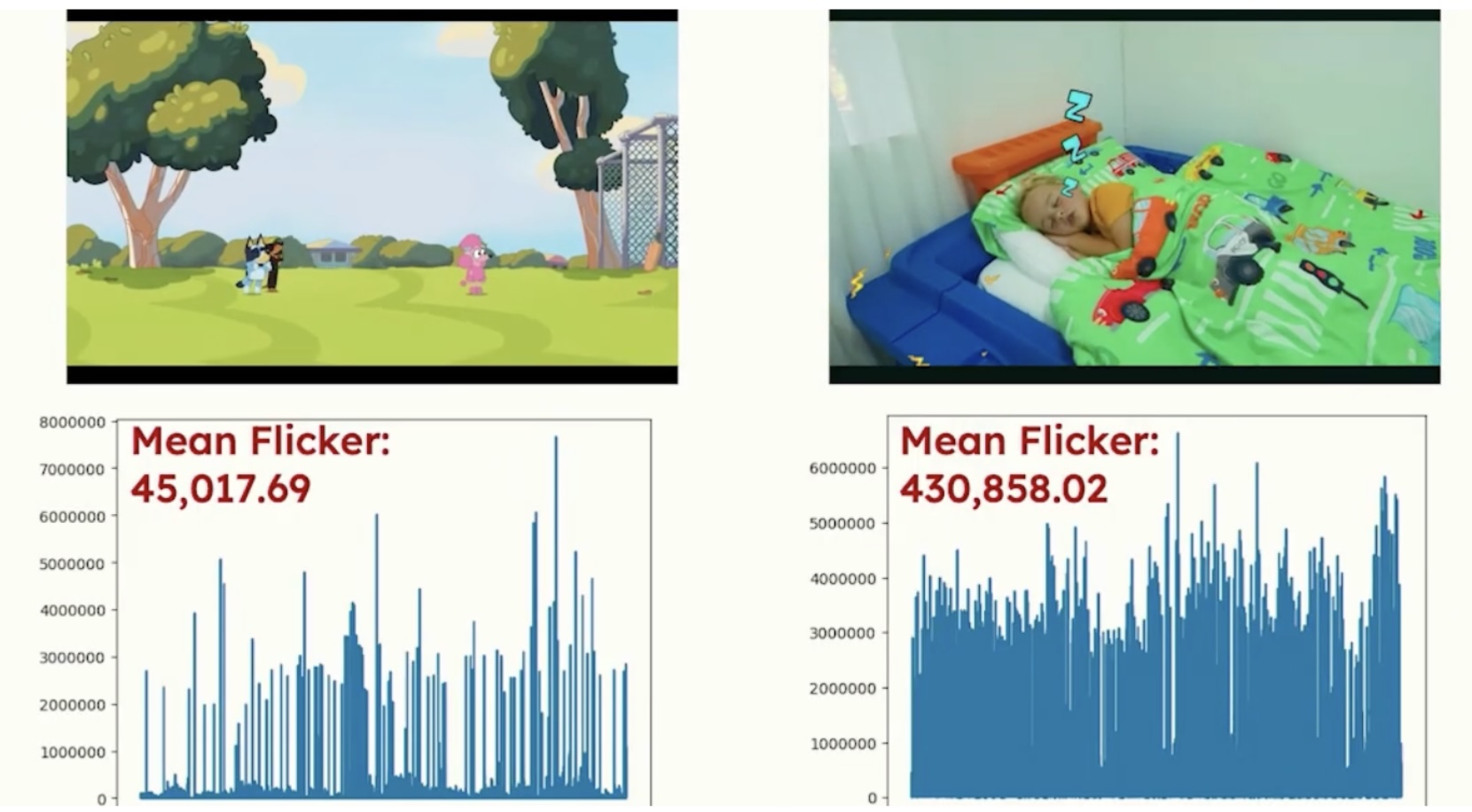
Not all screen time is created equal. A child watching Bluey is having a fundamentally different experience than one watching a fast-cut YouTube challenge video, even if the total viewing time is the same. Our Attention Capture feature measures that difference.
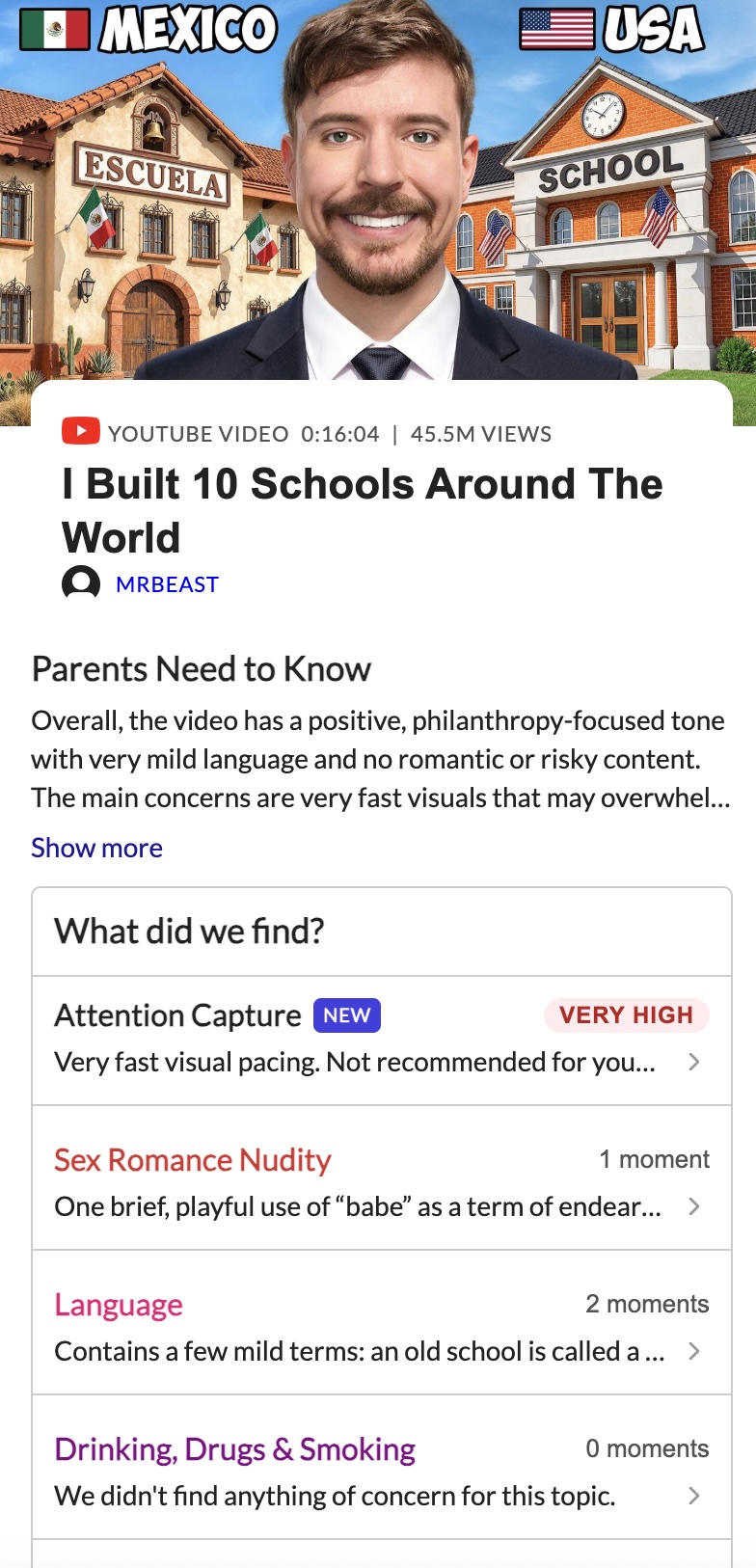
Attention Capture is measured using a metric called flicker, a computer vision measure of how rapidly and dramatically the visual scene changes from frame to frame. Rapid scene cuts, high-contrast color shifts, sudden motion, and constant visual complexity all drive up a video's flicker score. The higher the score, the more visually stimulating the content.
Flicker is an objective measurement, similar to how a decibel meter measures volume without rating a song. What matters is whether that level of visual stimulation is appropriate for a child's age and stage of development.
Attention Capture is included automatically in every video analysis.
The Research
What developmental science tells us
An emerging body of peer-reviewed research in developmental psychology has linked high-flicker visual media to disrupted cognitive outcomes in children, particularly in those under age 8, whose executive function and attentional control are still maturing. Studies have found that exposure to fast-paced media can immediately reduce children's ability to focus, inhibit impulses, and self-regulate.
For preschool-aged children, the effects are especially pronounced. High-flicker content has been associated with reduced executive function immediately after viewing, as well as longer-term shifts in attentional preferences. This can make slower, educational content feel less engaging over time, and make it harder for kids to focus in the classroom and persist with academic tasks.
Adolescents face a different but related concern. Their heightened reward sensitivity makes high-flicker content particularly hard to disengage from, contributing to disrupted sleep, heightened stress, and the gradual formation of attentional habits that may persist into adulthood.
The Levels
Four levels of Attention Capture
We report Attention Capture at four levels, each mapped to age-appropriate guidance based on current developmental research.
Calm, slow-paced visuals. Supports healthy cognitive development and is appropriate for all ages.
Moderate visual pacing. Generally appropriate for all ages, with standard screen time guidance.
Fast-paced visuals. Linked to reduced executive function in younger children; co-viewing encouraged for preschoolers.
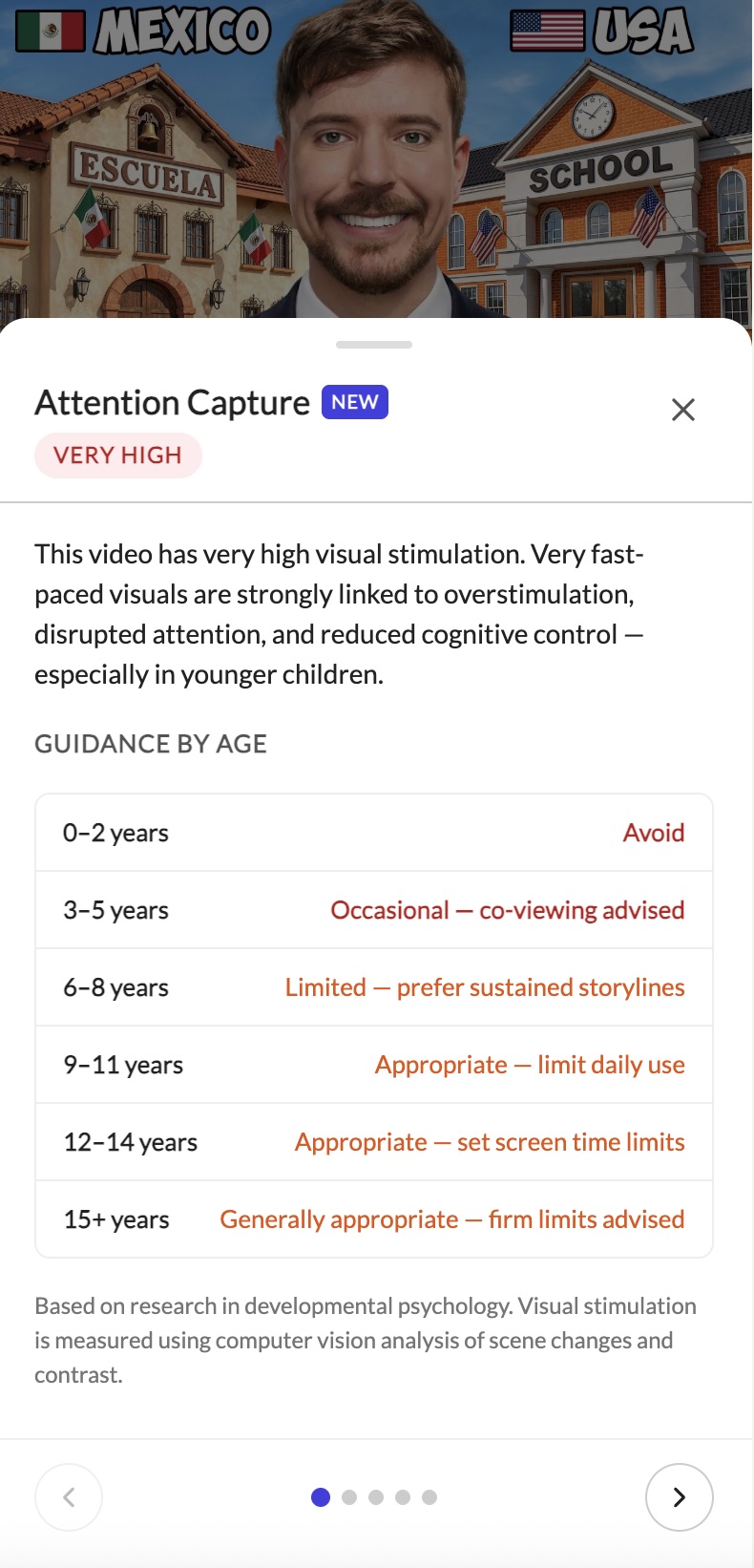
Very fast-paced. Strongly linked to overstimulation, disrupted attention, and reduced cognitive control — especially in young children.
Age-by-Age Guidance
What the research recommends by age
Our guidance is adapted from developmental psychology research and reviewed in collaboration with researchers at UC Berkeley. It reflects typical development. Every child is different, and parents know their child best.
| Age | Low | Medium | High | Very High |
|---|---|---|---|---|
| 0–2 years | Most appropriate | Most appropriate | Not recommended | Avoid |
| 3–5 years | Appropriate | Appropriate | Limited — co-viewing encouraged | Occasional — co-viewing advised |
| 6–8 years | Appropriate | Appropriate | Appropriate | Limited — prefer sustained storylines |
| 9–11 years | Appropriate | Appropriate | Appropriate | Appropriate with moderation |
| 12–14 years | Appropriate | Appropriate | Appropriate | Appropriate with moderation |
| 15+ years | Appropriate | Appropriate | Appropriate | Generally appropriate — firm limits advised |
Research Partnership
Developed with the UC Berkeley Kidd Lab
The Attention Capture feature was developed by Common Sense Media in collaboration with researchers at the UC Berkeley Kidd Lab, where ongoing work explores how children learn from and are affected by digital media. Our age-based guidance draws on peer-reviewed research including Shepherd & Kidd (2024), which demonstrated that visual engagement is not synonymous with learning: a child who appears captivated by a screen may not be benefiting cognitively.
Flicker scores are computed using computer vision analysis of scene changes and contrast across every frame of a video. No audio or content analysis is used in this measurement.
References
- Shepherd, S. S., & Kidd, C. (2024). Visual engagement is not synonymous with learning in young children. Proceedings of the Annual Meeting of the Cognitive Science Society, 46(0).
- Lillard, A. S., & Peterson, J. (2011). The immediate impact of different types of television on young children's executive function. Pediatrics, 128(4), 644–649.
- Essex, C., Gliga, T., Singh, M., & Smith, T. J. (2022). Understanding the differential impact of children's TV on executive functions. Infant Behavior & Development, 66, 101661.
- Kostyrka-Allchorne, K., Cooper, N. R., Gossmann, A. M., Barber, K. J., & Simpson, A. (2017). Differential effects of film on preschool children's behaviour dependent on editing pace. Acta Paediatrica, 106(5), 831–836.
- Christakis, D. A., Ramirez, J. S. B., Ferguson, S. M., Ravinder, S., & Ramirez, J.-M. (2018). How early media exposure may affect cognitive function. Proceedings of the National Academy of Sciences, 115(40), 9851–9858.
- Turatto, M., & Pascucci, D. (2016). Short-term and long-term plasticity in the visual-attention system. Neurobiology of Learning and Memory, 130, 159–169.